How much does land clearing cost per acre in Georgia?
If you own wooded or overgrown land in Georgia, clearing it typically costs $1,500 to $5,000 per acre, with the full market spread running about $1,200 on light brush up to $6,500 on dense hardwood with stumps and haul-off. Forestry mulching usually lands cheaper, around $1,200 to $3,000 per acre in Georgia, because nothing leaves the property.
Those are market ranges from published cost guides, not a quote. A real number for your property depends on what is growing on it, what happens to the debris, and what you want the ground to become. Here is how the pricing actually works, so a quote makes sense when you get one.
What does land clearing cost per acre in Georgia?
Georgia cost guides cluster around the same bands. Light brush and scattered saplings run about $1,000 to $2,000 per acre. Medium growth with small trees runs about $1,500 to $3,500. Heavy timber runs $2,200 to $6,000 and up. Grubbing, which means digging out stumps and roots so the ground is buildable, adds roughly $2,800 to $4,500 per acre on top.
| Scenario | Typical Georgia range |
|---|---|
| Light brush and grass | $1,000 – $2,000 / acre |
| Medium brush and small trees | $1,500 – $3,500 / acre |
| Heavily wooded | $2,200 – $6,000+ / acre |
| Grubbing (stumps and roots out) | $2,800 – $4,480 / acre |
| Forestry mulching | $1,200 – $3,000 / acre |
| Selective clearing (keep the good trees) | $1,500 – $4,000 / acre |
| Debris hauling add-on | $500 – $2,000 / acre |
| Rough grading after clearing | $1,000 – $3,000 / acre |
Around Statesboro the ground works in your favor. Most of Bulloch County is flat Coastal Plain sand, and slope is one of the big price multipliers elsewhere in the state. Cost guides add 20 to 40 percent on slopes past 20 degrees, a surcharge most local jobs never see.
Why do quotes for the same acre come back so different?
Because two contractors quoting “per acre” are often quoting two different jobs. The number moves on a handful of levers, in roughly this order.
Growth density. The spread between light brush and heavy timber is about three to one. Density sets machine hours, and machine hours are what you are really buying. A mulcher that covers 2 acres a day in brush covers half an acre a day in heavy timber.
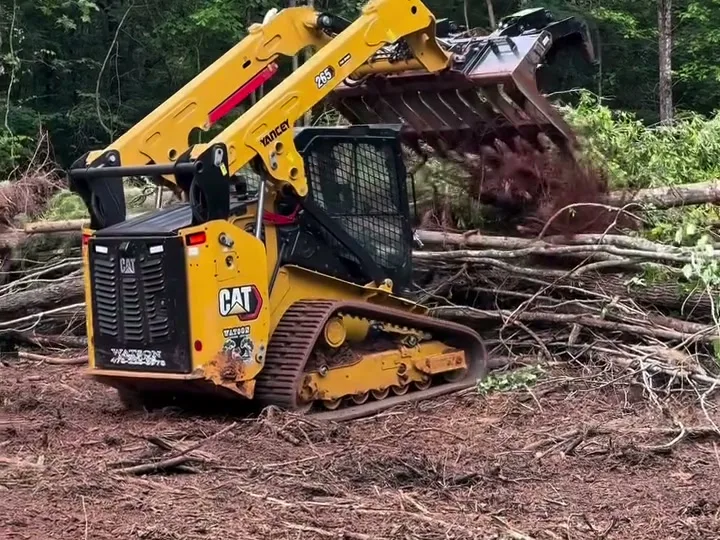
Debris disposal. This is the quiet fork in every quote. Mulching leaves the material on the ground as cover, so there is no disposal line at all. Piling and burning needs a Georgia Forestry Commission permit, and machine-piled clearing debris can require an air curtain destructor in some counties. Hauling debris off runs $500 to $2,000 per acre plus dump fees. Always ask which one a quote includes.
Stumps. Leaving stumps is free, and that is what forestry mulching does. Taking them out is its own line: published rates run $250 to $800 per stump for full extraction, and a wooded acre can hold 40 to 80 of them. That is why grubbing can cost more than the clearing itself, and why “cleared” and “buildable” are different products. Our stump removal page covers how we dig them out whole.
Access and job size. Mobilization runs a few hundred dollars to $1,500, and it costs the same whether the job is a quarter acre or ten. Small lots price high per acre for that reason, and per-acre pricing improves as acreage grows. If you plan to clear five acres eventually, one mobilization beats five.
Wet ground. Creek bottoms and low flatwoods around the Ogeechee stay soft after rain. Soft ground slows machines, forces reschedules, and near wetlands it can change the permitting picture entirely.
Do you need a permit to clear land in Georgia?
Sometimes, and the threshold is one acre. Georgia’s Erosion and Sedimentation Act exempts projects that disturb less than one acre, unless the work sits within 200 feet of the bank of state waters or belongs to a larger planned development. At one acre or more you need a Land Disturbing Activity permit from the local issuing authority plus a state NPDES notice, and the state fee is $80 per disturbed acre, or $40 to the state and $40 to the local authority where the county issues its own.
Two more Georgia rules worth knowing. Every state water carries a 25-foot undisturbed buffer, and the Ogeechee’s tributaries make that a live rule in Bulloch County. And the forestry exemption has a trap: land cleared under a forestry exemption generally cannot be developed for three years afterward. Inside Statesboro city limits, any development that clears or strips vegetation needs a Land Disturbing Activity Permit from the city; the Engineering Department at (912) 764-0655 confirms current requirements and fees.
Wetlands are the expensive one. Running clearing machinery through jurisdictional wetlands requires a federal Section 404 permit, and river-bottom ground around here is exactly where that bites. If part of your tract holds water, get an honest read on it before any machine touches it.
How do you keep the cost down?
Match the method to the goal instead of buying more clearing than the land needs. If you want the property open, walkable, and looking good, mulching covers it at the low end of the range. If you are building, budget clearing plus grubbing plus grading for the building footprint, and consider mulching the rest of the acreage. Most rural jobs around Statesboro end up as that hybrid, and it is usually the cheapest correct answer. Our guide comparing forestry mulching and land clearing walks through that decision, and the timeline guide covers how long each approach takes.
Clearing the debris question up front helps too. In Bulloch County you can burn with a permit year round, since the county sits outside Georgia’s 54-county summer burn ban. On jobs where burning fits, that beats paying to haul.
What a real number looks like
Every figure above is a market range. Your acre is not a market average, which is why we look at the property before quoting land clearing. The estimate is free, it happens on site, and it comes back as a real number with the disposal method and the finish condition spelled out. Call or text Watson Outdoor Living at (912) 712-6034 or request an estimate and we will tell you what your ground actually needs.