
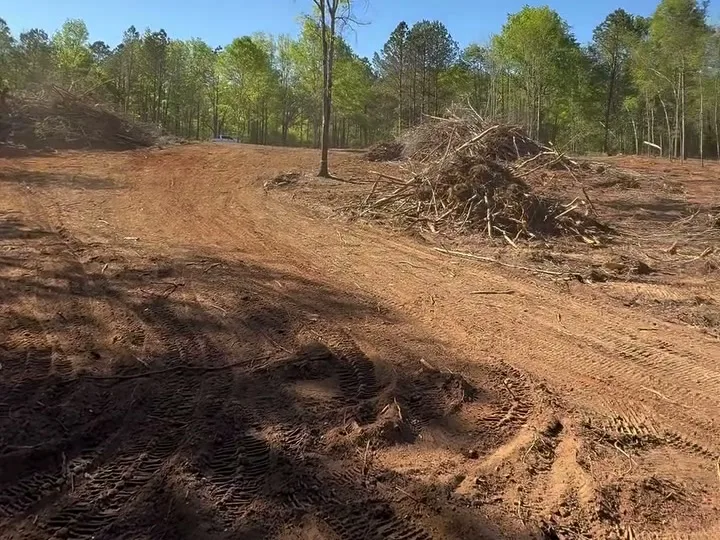
How long does it take to clear land?
Most 1-acre lots clear in a day or two of machine time. A forestry mulcher covers about 1 to 3 acres per day in moderate growth, and drops under an acre a day in heavy timber. Five acres of brush mulches in 2 to 4 working days, while five acres of dense hardwood with stump removal and haul-off can run one to two weeks.
The real answer is that acreage alone does not set the schedule. Two five-acre properties can be completely different jobs. What is growing, where the debris goes, and what the ground is doing that week set the timeline, and this guide walks through each so your expectations land where the machines will.
How long does one acre take?
For a single mulching machine, published production guides put one acre at 4 to 12 machine hours depending on density. In practice around Statesboro that means:
| Job | Realistic time on site |
|---|---|
| Light brush and saplings, 1 acre, mulched | Half a day to a day |
| Mixed brush and small trees, 1 acre | 1 to 2 days |
| Heavy timber, 1 acre, cleared with haul-off | 3 to 5 days |
| Overgrown backyard reclaim | Usually 1 day |
| 5 acres of brush, mulched | 2 to 4 days |
| 5 acres of dense woods, clear and grub | 1 to 2+ weeks |
Those bands match what we see on our own land clearing and forestry mulching jobs: a two-backyard mulching project is a day, a wooded couple of acres is most of a week when the stumps come out.
Why does debris set the schedule?
Because clearing is really two jobs: putting vegetation on the ground, then dealing with it. The second half is the fork in the schedule.
Mulching skips it entirely. The material becomes ground cover where it stands, so when the machine finishes grinding, the job is done. That is the main reason mulched acres finish in a fraction of the time.
Traditional clearing has to pile everything, then burn it or haul it. Burning needs a Georgia Forestry Commission permit, which is issued for the day of the burn, and the weather has to cooperate. Hauling means loader cycles and truck trips that scale with how much timber was standing. Either path adds days to the same acreage, which is also why it adds dollars; the cost guide breaks that side out.
Stumps are the other big adder. Grinding one stump takes an hour or two, and digging one out with the excavator takes longer still, but dig-outs bundled into a clearing job go fast because the machine is already working the ground. A wooded acre can hold dozens of stumps, so “stumps out” versus “stumps left” can swing the schedule by days. Our stump guide covers which finish your project actually needs.
What does the whole project look like?
The machine days are the visible part. A typical job runs this sequence:
- The look. We come see the property, talk through what you want the land to become, and get you a number. Free, and usually within a few days of your call.
- Scheduling and prep. Utility locates get marked before any digging. If the job disturbs an acre or more, permits enter the picture, covered below.
- Machines on site. The CAT 265 mulches or grapples, the CAT 308 fells, digs, and loads. Most residential jobs are one mobilization.
- Stumps and debris. Dig-outs, piling, burning, or trailer loads, per whatever the estimate spelled out.
- Rough grade and walkoff. The ground gets knocked smooth where the work tore it, and we go over the finished property with you before we leave. If the plan calls for a pad or drainage shaping, grading picks up from here.
Do permits change the timeline?
Under an acre, usually not: most small residential clearing in Georgia is exempt from land-disturbance permitting unless it sits within 200 feet of state waters. At one acre or more, the job needs a Land Disturbing Activity permit from the city or county, and Georgia’s construction stormwater permit requires the notice of intent to be filed at least 14 days before ground breaks. Practical translation: for a permitted job, plan on two to three weeks between deciding and machines rolling, and use that window for scheduling anyway. Inside Statesboro city limits, the city requires a permit for development clearing at any size, so we confirm with the county or the city Engineering office before quoting a start date.
What about weather and season?
Southeast Georgia lets us work year round, and each season trades something. Winter ground is firmer, growth is dormant, and calendars are lighter, which makes it the underrated season to book. Summer works fine between storms, but saturated Coastal Plain sand loses its bearing fast, and a machine on soaked ground cuts ruts that cost more to fix than the delay would have. When a tropical week soaks the county, jobs slide a few days, and that is the machine respecting your property.
One local advantage: Bulloch County is not in Georgia’s 54-county summer burn ban, so on jobs where burning is the debris plan, a permitted burn stays available in any month. Metro-county landowners lose that option for five months a year.
Getting a real date
Everything above is a band, and your property is a specific job. When we look at it, you get a real number and a real timeline together: how many machine days, what happens to the debris, and what week we start. Call or text Watson Outdoor Living at (912) 712-6034 or request a free estimate, and we will tell you how long your land actually takes.