
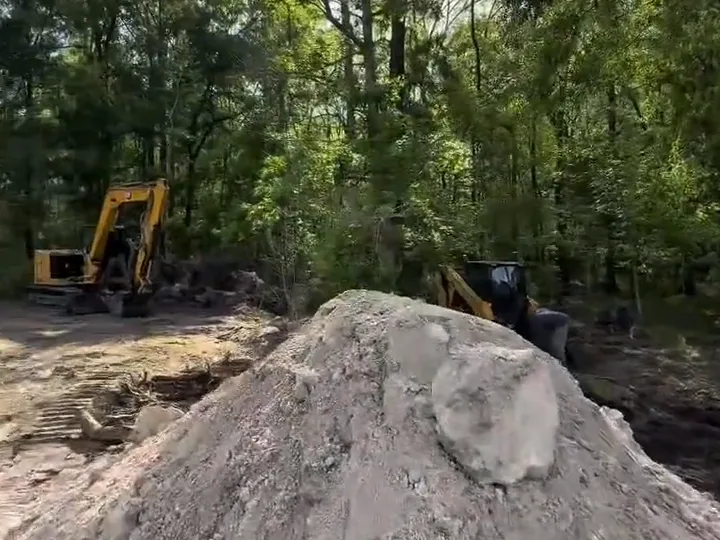
How much does fill dirt cost in Georgia?
HomeGuide puts fill dirt cost at $5 to $25 per cubic yard, or $4 to $15 per ton delivered. HomeGuide prices a dump truckload at $150 to $400 with delivery. Angi puts the 2026 national average for fill dirt at $842, based on 4,281 verified projects. On a pad or a low spot, the hauling, spreading and packing add to that.
What does fill dirt cost per yard and per truckload?
Three national guides publish fill dirt prices. Some quote the dirt alone, and some include the delivery. The table shows who says what.
| Item | Published price | Source |
|---|---|---|
| Fill dirt, per cubic yard | $5 to $25 | HomeGuide |
| Fill dirt, per ton, delivered | $4 to $15 | HomeGuide |
| Clean fill dirt, per cubic yard | $8 to $25, plus $15 to $60 for delivery | HomeGuide |
| Structural fill, per cubic yard | $10 to $30 | HomeGuide |
| Dump truckload of fill, 10 to 14 cubic yards | $150 to $400 with delivery | HomeGuide |
| Rough spreading after delivery | $200 to $400 | HomeGuide |
| Unscreened fill, per cubic yard | $8 to $15 | Angi |
| Structural fill, per cubic yard | $15 to $25 | Angi |
| Fill dirt, 2026 national average | $842 | Angi |
| Fill dirt alone, per cubic yard | $6 to $17 | Lawn Love |
HomeGuide says its fill prices depend on the type, the volume ordered and the distance away. Angi’s yard leveling guide puts fill at $5 to $30 per cubic yard, wider than its fill dirt guide. Read every row as a national starting point.
The delivery terms matter as much as the price. HomeGuide’s truckload price assumes free delivery up to 10 miles and no installation. HomeGuide also says delivery is a single dump and does not move the dirt into a backyard. Lawn Love’s $6 to $17 per cubic yard covers the dirt alone, before the fee for spreading it.
Who hauls the fill, and who spreads it?
We haul fill in as part of a pad, a low spot or a grading job. Then we spread it, shape it and pack it down. We do not sell or deliver fill by the load on its own. If all you need is a load dumped in the yard, that is a job for a dirt supplier.
HomeGuide says fill dirt and topsoil often show up as their own lines on a grading quote. So ask whether the dirt, the hauling and the spreading each sit inside a number. On our jobs, hauling in fill for pads and low spots includes the spreading and the packing.
A pile already sitting in your driveway is a smaller job. The CAT 275 track loader can push it where it belongs. That falls under spreading a pile that is already dumped.
How much fill dirt does a house pad take?
Angi’s method works for any pad. Multiply the length, width and depth in feet, then divide by 27 to get cubic yards. HomeGuide says to add 5% to 10% for waste and spills.
Take a pad 40 by 60 feet, built up 1 foot. That is 2,400 cubic feet, or about 89 cubic yards. HomeGuide says one truckload typically holds 10 to 14 cubic yards, so that pad takes about 7 to 9 loads. At HomeGuide’s $5 to $25 per cubic yard, the fill runs about $445 to $2,225.
A shed pad is smaller math. A 12 by 16 foot pad raised 6 inches takes 96 cubic feet, or about 3.6 cubic yards. That is less than half of one truckload by HomeGuide’s count. Angi says suppliers often set minimum orders, which can push up the price on small jobs.
Leveling a whole yard is its own job, and our guide to yard leveling prices covers it. The pad math above is for building ground up in one spot.
What does a house pad or building pad cost?
Published guides price a pad as site work. HomeGuide lists a foundation pad for a new home site at $1,500 to $10,000. HomeGuide prices excavating a driveway, patio or deck dirt pad at $1,000 to $2,500. It says that work typically includes grading and compacting the dirt.
Angi’s site prep guide puts the 2026 national average at $3,800, with most homeowners spending $1,300 to $5,600. Angi averages a 1,000 square foot shed pad at $1,500. HomeGuide prices residential cut and fill at $1 to $15 per cubic yard. Cut and fill moves dirt from high ground to build up low ground.
A house pad carries more weight than a shed pad. Georgia’s residential code says fill under footings and foundations must be designed, installed and tested by accepted engineering practice. Angi calls structural fill engineered for compaction and stability, the right choice under foundations or roads.
HomeGuide says structural fill typically goes under a new foundation. In HomeGuide’s guide, that work requires permits and inspection fees starting at $400. It adds that a soil engineer signs off on the fill and provides a soil report.
Your plans set the pad height. We strip the topsoil, then pack the fill in layers with the track loader.
What does it cost to prep land for a mobile home?
HomeGuide puts the average cost to prepare land for a manufactured home at $4,000 to $11,000. That range depends on the land clearing, excavation and grading the lot needs. HomeGuide prices the foundation separately, once the land is clear and level.
A wooded lot adds the clearing first. Pines and stumps come off the spot before any fill goes down. We dig stumps out whole with the CAT 308 excavator, so no roots rot and sink under the pad. That step runs as clearing a wooded home site.
Our part ends at a packed, level pad. The foundation crew takes it from there.
What moves the price of fill around Statesboro?
Distance comes first. Every load is a round trip, and HomeGuide’s truckload prices assume free delivery up to 10 miles. A pad far from the source of the dirt costs more to build.
Packing comes second. Angi says spreading and compacting with heavy machinery may be billed separately. Angi puts a skid steer or compactor at $100 to $300 per day, unless the contractor’s fee covers it. Fill packed in thin layers takes longer than one load spread flat.
Prep is the third. Angi puts site prep on a fill dirt project at $200 to $800. That covers clearing vegetation, grading, minor excavation and debris removal. We strip the topsoil first so the fill sits on firm ground.
The ground itself is the last one. Around Statesboro it is sandy loam and loamy sand over clay. HomeGuide warns against driving a loaded dump truck across a yard when the ground is wet or damp. After a long rain, the loader and the dump trailer wait for the ground to firm up.
What if the low spot holds water?
Low bottoms around Statesboro hold water after rain. Fill can raise that ground, but the water still needs somewhere to go. Angi says fill dirt can settle or shift over time and leave low spots. It ties proper spreading and compaction to fewer settling and drainage problems later.
One of our jobs shows how the two fit together. It was an extended culvert set for drainage, nine loads of fill hauled in and a tight final grade. Where water stands, we look at drainage fixes for standing water along with the fill.
Around a house, the code sets the slope off the pad. Georgia’s residential code wants a drop of at least 6 inches over the first 10 feet out from foundation walls. That slope gets cut in as rough grading around a new pad.
Wet ground can also be a wetland. The Army Corps of Engineers requires its permit before fill goes into any waters of the United States, wetlands included. Check creek bottoms before any fill goes in.
Do you need a permit to bring in fill dirt?
For most small pads, not from the state. Georgia’s erosion and sedimentation law exempts land disturbance under one acre. Work near state waters is one exception. Your city or county may add its own rules, so ask before the first load.
Georgia 811 says to contact 811 before you dig. That call goes in before our machines cut into the ground.
How do you get a price on a pad or a low spot?
Every price starts with a look at the ground in person. We check how low the spot sits, where the water goes and how far the fill has to travel. Estimates are free.
It helps to know the size of the pad and what will sit on it. Tell us if trees or stumps are still on the spot. Call or text (912) 712-6034, or send us the size of your pad. See how we build and pack a pad for the whole job from clearing to the final grade.