
How much does land grading and yard leveling cost in Georgia?
HomeGuide puts regrading a small lawn at $500 to $1,000 and the average backyard at $1,000 to $5,000. HomeGuide’s national average is $2,300, and its land leveling range is $0.40 to $2.00 per square foot. Angi’s 2026 guide puts the national average at $2,175, based on 5,354 projects. Around Statesboro, the price follows how much dirt has to move and where the water has to go.
What does land grading cost by project?
Three national cost guides publish grading prices by project. Angi and Lawn Love both updated theirs in October 2026. Most rows land close together, and driveways show the widest spread.
| Job | HomeGuide | Angi | Lawn Love |
|---|---|---|---|
| National average | $2,300 | $2,175 | $1,700 |
| Typical range | $500 to $5,000 | $1,022 to $3,329 | $770 to $3,000 |
| Grading around a house for drainage | $500 to $3,000 | $1,000 to $3,000 | $835 to $3,000 |
| Leveling for a patio or deck | $500 to $1,000 | $500 to $4,500 | $670 to $4,500 |
| Leveling for new construction or an addition | $1,000 to $5,000 | Not listed | $1,000 to $6,700 |
| Driveway grading | $700 to $2,500 | $1,500 to $9,500 | $1,000 to $5,125 |
| Quarter acre lot | $4,400 to $10,900 | $4,200 to $11,250 | $3,950 to $11,134 |
| One acre | $17,400 to $43,600 | $17,000 to $45,000 | $15,800 to $44,535 |
These are national figures, so treat them as a starting point. Lawn Love bases its $1,700 average on a 1,200 square foot lot at $1.40 per square foot. HomeGuide says most residential grading projects are a quarter acre or less. We price land grading and yard leveling after a look at the ground, and the estimate is free.
Is rough grading cheaper than finish grading?
By the square foot, yes. HomeGuide puts fine or finish grading, the top 1 to 3 inches, at $0.40 to $1.00 per square foot. HomeGuide prices rough grading, which removes slopes or shapes a yard for drainage, at $1 to $2 per square foot. Lawn Love lists rough grading at $1.00 to $2.00 per square foot as well.
Area is what makes those rates add up. At HomeGuide’s rough grading rate, a 50 by 100 foot backyard works out to $5,000 to $10,000. So the first question on any yard is how much of it needs dirt moved.
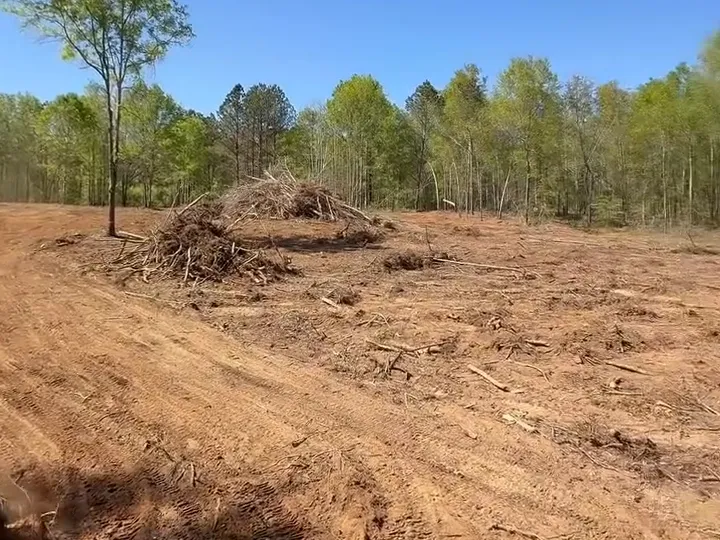
Freshly cleared ground usually prices as rough grading. Stump holes and ruts get cut and filled before any smoothing pass. The finish work comes last, once the shape and the fall are set.
What does it cost to grade around a house for drainage?
HomeGuide puts grading around a house for drainage at $500 to $3,000. The top of that range, $1,000 to $3,000, is HomeGuide’s price for grading around the entire house. Angi lists regrading around a foundation at the same $1,000 to $3,000.
The target comes from the building code. Georgia’s residential code says the ground must fall at least 6 inches within the first 10 feet from the foundation. HomeGuide cites the same rule from the International Residential Code.
On a flat Statesboro lot, those 6 inches have to come from somewhere. Dirt cut from the high side can build up the ground at the house. When the yard cannot spare it, fill comes in on the dump trailer, and that adds to the bill.
Some lots cannot give 6 inches of fall at all. Where lot lines or walls get in the way, the code calls for drains or swales instead. That part of the job is our drainage and swale work.
How much do fill dirt and topsoil add?
HomeGuide puts fill dirt at $5 to $25 per cubic yard and topsoil at $10 to $50. Angi lists fill at $5 to $30 per cubic yard and topsoil at $12 to $55. Lawn Love prices fill dirt at $6 to $17 per cubic yard, with the spreading fee added on top. HomeGuide also says many grading contractors charge for fill dirt and topsoil separately.
The math is easy to run on your own yard. HomeGuide says one cubic yard of dirt covers 55 square feet at 6 inches deep. Raising a 20 by 30 foot low spot by 6 inches takes about 11 cubic yards. At HomeGuide’s fill price, that is about $55 to $275 worth of dirt.
Dirt already in your yard costs nothing to buy. HomeGuide says grading contractors cut dirt from high areas to build up low areas. Angi says the fill you need depends on how much can be moved from elsewhere in your yard.
Low bottoms that hold water after rain often need more dirt than the yard can spare. Raising that ground with fill brought in falls under our dirt work for low spots and pads. One job of ours paired an extended culvert for drainage with nine loads of fill and a tight final grade.
What do grading operators charge by the hour?
HomeGuide says operators with their own skid steer loader charge $100 to $300 per hour. Angi puts yard leveling labor at $40 to $180 per hour. Lawn Love lists the same $40 to $180 per hour, with machine and operator fees included.
We grade with a CAT 275 compact track loader and a CAT 308 excavator. Whatever slows those machines down shows up in the price. Spoil and debris leave on the dump trailer, so hauling is part of the job too.
Access is the big one. The track loader needs a way into the backyard and firm ground under it. A fence with no wide gate, or soft ground after a long rain, adds time. Angi’s tip is to clear furniture and debris out of the yard first, which cuts hourly labor.
What makes a Statesboro yard cost more or less to grade?
Statesboro sits in flat Coastal Plain country, so grading here is mostly about water. A flat lot needs a long, gentle fall to carry rain to a ditch or a low corner. Setting that fall across a whole yard moves more dirt than knocking down one hump.
Trees and stumps still on the lot add to the bill. HomeGuide says clearing trees and large rocks before grading costs more. Planted pine and sweetgum leave root mats behind, and the root rake grapple pulls them before any shaping. On our jobs, stumps come out whole with the excavator, so nothing rots and sinks under the new grade.
If trees are still standing, budget the clearing first. Our guide to what clearing costs per acre covers that side of the bill.
Weather moves the schedule and sometimes the price. HomeGuide says the best time to regrade is spring or fall in dry weather. HomeGuide also says to reseed or lay sod right after grading so the soil stays in place. Bare sandy ground washes in a summer downpour, so plan the grass with the grade.
Do you need a permit to grade a yard in Georgia?
Georgia law exempts any project that disturbs less than one acre, with exceptions such as work near state waters. That line covers most yard jobs, since HomeGuide puts most residential grading at a quarter acre or less. Your city or county may add its own rules, so ask before work starts.
Where a grading permit applies, HomeGuide puts it at $50 to $400. Angi lists permits at $100 to $500. Our guide to Georgia’s land clearing permit rules covers the one acre line in detail.
Georgia 811 says to contact 811 before you dig. Georgia 811 also says the service is free of charge. Grading cuts into the ground, so that call comes before the machines start.
How do you get a price on your yard?
A grading price starts with a look at the ground in person. Photos rarely show how a yard falls or where water sits after rain. We check both, then tell you what the grade needs and whether fill has to come in. Estimates are free.
It helps to know roughly how big the area is and where water stands after a storm. Tell us if stumps or roots are still in the ground. Call or text (912) 712-6034 to set a time. See how we shape a yard to shed water for what the work covers.