How much does a driveway culvert cost in Georgia?
Angi puts professional culvert replacement at $1,000 to $9,000, with an average around $4,500. HomeGuide’s gravel driveway guide lists culverts or drains at $500 to $2,000. At a Bulloch County road, the county sets the pipe itself, and its fee list starts at $678.98. Where your driveway culvert cost lands depends on the pipe and on whose ditch it sits in.
What does a driveway culvert cost?
The national guides price a whole job. Bulloch County prices only the pipe it sets in its own right of way. Both kinds of numbers sit in the table below.
| Item | Published price | Source |
|---|---|---|
| Culvert replaced by a pro | $1,000 to $9,000 | Angi |
| Average pro replacement | About $4,500 | Angi |
| Culverts or drains on a gravel drive | $500 to $2,000 | HomeGuide |
| Plastic pipe, 24 inch by 20 feet | $700 | Angi |
| Aluminum or galvanized steel pipe, 24 inch by 20 feet | About $800 | Angi |
| 15 or 18 inch pipe set by Bulloch County | $678.98 per installation | Bulloch County |
| 24 inch pipe set by Bulloch County | $922.94 per installation | Bulloch County |
| Right of way permit for a drive you or a contractor put in | $50 base plus $0.50 per linear foot | Bulloch County |
Angi says its range may or may not include stone or sod to line the ditch. It usually covers resurfacing the part of the drive that sat on top of the pipe. We price each culvert after seeing it, so treat the table as published starting points. Our page on culvert crossings for gravel driveways covers how that work runs.
What changes the price of a driveway culvert?
Length comes first. Bulloch County’s road policy says driveway pipe must be at least 16 feet long and no more than 32 feet. The County Engineer may grant an exception. Every extra foot adds pipe to buy and trench to dig.
Diameter is next. Angi says a driveway pipe is typically 10 or 12 inches across, occasionally smaller or larger. Bulloch County’s own fee list starts at 15 inches and runs to 24. Pipe along a state highway has its own minimum, covered below.
Angi ties its range to the length and type of pipe and to your driveway material. The fill over the pipe and the treatment on its ends add to that. Low bottoms around Statesboro hold water after rain. A crossing there can need more fill to sit high and dry.
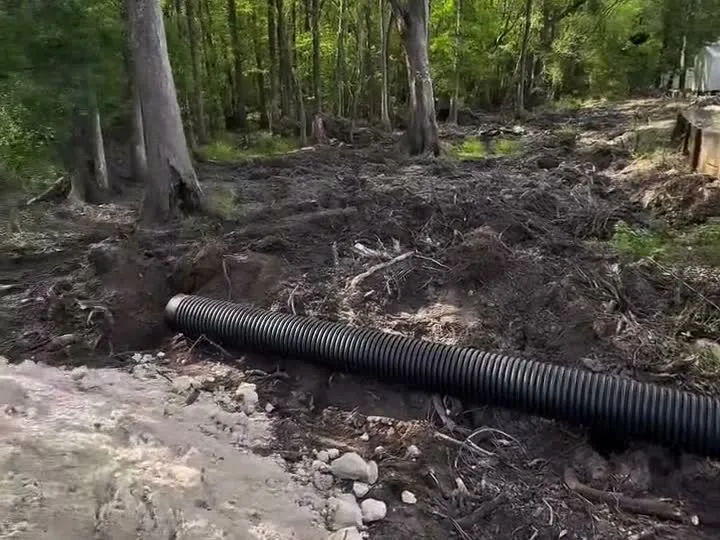
On one of our jobs, an extended culvert went in for drainage. Nine loads of fill came in, and the job finished on a tight final grade. Hauling in fill to raise a crossing is part of our fill and site prep work.
Which pipe works best under a driveway?
Angi says culvert pipe usually comes in aluminum, galvanized steel, plastic or concrete. Galvanized steel suits high traffic areas, but Angi warns it can rust and form weak spots. Aluminum and plastic will not rust, though neither one is as strong as steel.
Plastic is the light one. Angi says plastic culvert pipe is lightweight and easier to install, and better suited for low traffic areas. Angi prices a 24 inch plastic pipe 20 feet long at $700. Aluminum or galvanized steel in that size runs about $800.
A state highway narrows the choice. Georgia DOT’s residential driveway rules allow reinforced concrete, corrugated aluminum, corrugated galvanized metal and HDPE plastic, among others. Smooth lined PVC is allowed only along low volume roads, under 1,500 vehicles a day. Pipe that carries a ditch under a farm road or a path falls under our culvert pipe and ditch work.
What goes on the ends of the pipe?
Georgia DOT requires safety end treatments on side drain pipes on all state routes. The exceptions are pipe ends outside the clear zone or behind guardrail. GDOT says the sloped end lets a car travel across the pipe end instead of stopping hard. It also helps control erosion and makes mowing easier.
Bulloch County uses the same tool on its roads. The County Engineer may require safety slope end sections where pipe ends are exposed to traffic inside the clear zone. Any side drain pipe larger than 36 inches needs a headwall at the inlet and the outlet. GDOT draws that headwall line at pipe larger than 48 inches.
What goes over the pipe?
Angi warns that a badly installed culvert may not be strong enough to hold the weight of your car. It can buckle or crack under that load. We set the pipe on the fall of the ditch, then pack fill back in around it. The drive’s base and stone go on last.
Georgia DOT sets a minimum clearance of 1 foot over drainage structures on state highways. It measures from the bottom of the pavement structure to the top of the pipe. The approach on either side of the crossing gets shaped so water sheds off it. That shaping is part of our grading work on drives and lots.
Who sets the pipe at a Bulloch County road?
Bulloch County controls the pipe in its own right of way. Its road policy puts every new residential drive on a county maintained road under a County Engineer permit. The fees cover the county buying and installing the pipe needed to keep water moving in the ditch. The engineer advises on where the drive goes and what pipe sits under it.
If the county does the installing, the policy waives the permit fee. The table above shows what those county installs cost by pipe size. The policy says the county will only maintain what it installs.
The policy leaves room for private work too. The County Engineer may waive county installation in some cases. The policy also sets standards for drives that private contractors and individuals put in. A self or contractor installed residential drive costs $0.50 per linear foot on top of a $50 permit base.
Skipping the permit costs double the original fee or a citation, by the county’s fee list. Digging up the apron or the right of way beside it needs a permit too. Cleaning a clogged culvert pipe does not. Bulloch County takes driveway access permit applications through an online portal on its Roads page.
Our side of the work starts at the right of way line. We set culvert pipe at ditch crossings and farm entrances on your property. Then we build the gravel drive on your side of that line.
Bulloch County permits farm use driveways case by case. Approval turns on how deep the ditch out front runs and how big a pipe the storm water needs. The per foot charge on the fee list is $0.00 for a farm driveway.
What about a driveway on a state highway?
State routes follow Georgia DOT’s driveway manual. Bulloch County’s policy says residential drives on a state highway get built to GDOT standard specifications. Residential driveway permits on state routes go through a GDOT Area Engineer. In Bulloch County, that is the Statesboro Area Office, which also serves Candler, Effingham, Evans and Screven counties.
A GDOT permit inspector advises on the drive’s location and on any pipe it needs. The minimum for side drain pipe on the State Highway System is 18 inches. Pipe ends should reach far enough to keep at least a 6 foot shoulder. GDOT says residential drives normally run 14 to 16 feet wide.
Two more GDOT rules matter on rural land. GDOT will not approve individual drives for newly subdivided lots under 5 acres. Those smaller lots get a shared drive or a subdivision street. Upkeep of the pipe and drive up to the edge of the pavement falls on the property owner.
Bryan, Chatham and Liberty counties fall under GDOT’s Savannah Area Office for state routes. On a county road outside Bulloch, ask that county’s road department about its driveway permit before work starts.
When does an old driveway culvert need replacing?
Angi says water building up at the end of your driveway can be a sign of culvert trouble. It also says a rusted out or damaged culvert is generally not worth repairing. A new pipe takes less time and will likely last longer than a repair, by Angi’s account.
Pulling an old pipe at a Bulloch County road means digging the apron, and that needs a permit. Angi says to contact your utility company to locate buried lines before any digging. Georgia 811 says to contact 811 before you dig, and its service is free of charge.
What does an estimate for a driveway culvert involve?
Our estimates start at the ditch itself. We check the fall of the ground and how much fill the crossing will take. The estimate is free.
Call or text (912) 712-6034 to book a look at the crossing. You can also tell us about your ditch crossing and we will get back to you. It helps to know whether the drive meets a county road or a state highway. For the rest of the drive, our Georgia gravel driveway price guide covers the stone and base.