
How much does concrete removal cost in Georgia?
HomeGuide puts concrete removal at $3 to $8 per square foot, disposal included. Angi’s 2026 figures run $2 to $6 per square foot, labor and dumping included. Angi puts the national average at $1,139, based on 1,330 verified projects. Most homeowners pay $542 to $1,744, and Angi says thickness, rebar and disposal fees drive that spread.
What does concrete removal cost by job?
Both national guides price the common jobs one at a time. The table puts HomeGuide’s ranges beside Angi’s 2026 figures, with the source on every row.
| Job | Published range | Source |
|---|---|---|
| Concrete removal, per sq ft, disposal included | $3 to $8 | HomeGuide |
| Concrete removal, per sq ft, labor and dumping included | $2 to $6 | Angi, 2026 |
| Reinforced concrete, per sq ft | About $6 or more | Angi, 2026 |
| Rebar, extra per sq ft | $1 to $3 more | HomeGuide |
| Driveway, 200 to 600 sq ft | $1,200 to $4,500 | HomeGuide |
| Driveway removal | $1,000 to $2,500 | Angi, 2026 |
| Slab, 10 x 10 feet | $300 to $800 | HomeGuide |
| Slab removal | $800 to $2,500 | Angi, 2026 |
| Patio, 20 x 20 feet | $1,200 to $3,000 | HomeGuide |
| Patio removal | $1,000 to $2,000 | Angi, 2026 |
| Sidewalk, 50 feet long | $750 to $1,250 | HomeGuide |
| Sidewalk removal | $900 to $2,500 | Angi, 2026 |
| Southeast city markets, per sq ft | $6 to $10 | Angi, 2026 |
HomeGuide also prices concrete by size, for slabs 3 to 6 inches thick. Its table runs $300 to $800 for 100 square feet and $1,500 to $4,000 for 500. A 1,000 square foot job runs $3,000 to $8,000 in that table. The low end is unreinforced concrete and the high end is reinforced.
These ranges come from national cost guides. We price each job after looking at the concrete in person, and the estimate is free. The table gives you a budget range before anyone comes out.
How does concrete come out on our jobs?
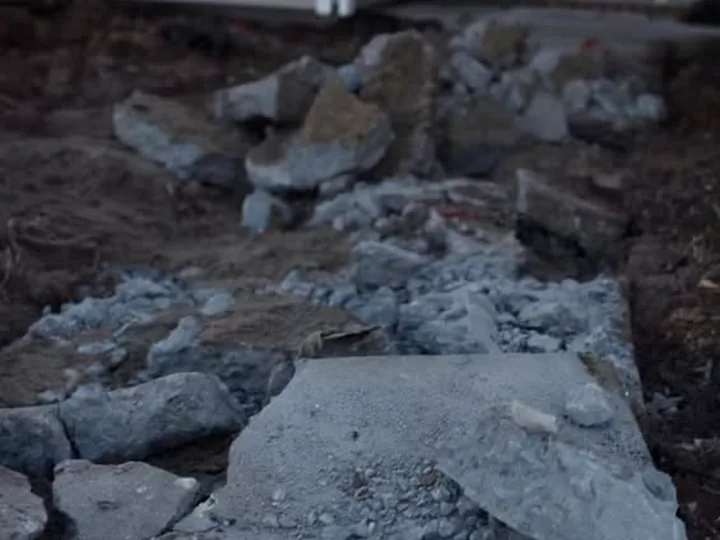
HomeGuide says contractors usually break concrete up with a jackhammer or an excavator, depending on size and thickness. It also says slab removal typically takes both a jackhammer and a concrete saw. On our jobs the CAT 308 excavator does the breaking. It cracks the slab into pieces small enough to lift.
The root rake grapple on our track loader picks up those pieces and loads them into the dump trailer. Rebar and wire mesh come out with the concrete. Once the slab is gone, the dirt underneath gets raked and shaped. That is how concrete gets broken out and hauled off on our jobs around Statesboro.
Most of these jobs are one slab on one property. HomeGuide says removing 100 to 200 square feet of sidewalk takes 2 to 4 hours. It says most concrete slabs take 1 to 2 days. Ours usually run a half day to a day or two.
Access sets the pace too, since the machines and the dump trailer need room to reach the slab. Angi says hard to reach, hazardous or steep spots often push removal to $6 per square foot or more. We check the path in when we come out to price the job.
What makes one slab cost more than another?
Thickness comes first. Angi says contractors treat 4 to 6 inches as the standard thickness for removal. A slab even 1 or 2 inches past that can lead contractors to double their price, Angi says. HomeGuide says slab demolition is cheapest for slabs under 4 inches thick with no reinforcement.
Rebar comes next. HomeGuide says rebar adds $1 to $3 per square foot, for cutting and disposing of it. Angi puts reinforced concrete at about $6 per square foot or more. Angi says reinforcement is most common in slabs thicker than 6 inches.
Size works the other way. HomeGuide says smaller concrete removal jobs cost more per square foot than large ones. So a short walkway can price high for its size.
The type of job matters as well. HomeGuide says breaking up a driveway costs more than slab demolition because of the excavator the job needs. A patio attached to the home or with masonry built in costs more to remove, HomeGuide says.
Sidewalks are simpler in one way. HomeGuide says most are not reinforced, which cuts labor time. It says prices rise for sidewalks more than 6 inches thick.
Location shows up in the price too. Angi says urban contractors charge more than rural ones, at $6 to $14 per square foot in city markets. HomeGuide says mileage fees apply when concrete has to travel a long way for disposal.
What does disposal add to the price?
HomeGuide puts hauling and dumping concrete at $30 to $65 per pickup truck load. That covers up to 6 cubic yards of debris. It puts dump fees at $90 to $160 per ton, set by local landfill policy. Angi says disposing of 2 tons of concrete yourself, with truck rental and dumping fees, runs around $550.
Quotes treat disposal in different ways. Angi says some contractors bundle disposal into the per square foot rate. Others add $0.50 to $2 per square foot on top, Angi says, so confirm what a quote covers. With us, hauling the broken concrete away is part of the job.
Bulloch County’s convenience centers are not a place for that load. The county says commercial contractors and other businesses are prohibited from dumping there. Our loads of broken concrete go to a disposal site that accepts them.
How does Georgia classify broken concrete?
Georgia’s solid waste management rules, chapter 391-3-4, class broken concrete as construction and demolition waste. Their definition covers rubble from demolition operations on pavements, houses, commercial buildings and other structures. Concrete is named on that list, along with wood, bricks and metal.
The same rules keep a short list for inert waste landfills. Concrete is on it, along with earth, rock, bricks, cured asphalt, stumps, limbs and leaves. The rules say a construction and demolition landfill may take inert waste too.
Can broken concrete be reused as fill?
The state rules leave room for it, with conditions. Georgia’s rules exclude recovered materials from regulation as solid waste. The material needs a known use that is practical. It also has to be pulled from the waste stream for that use.
The rules also point to a state guidance document on recovered clean concrete as structural fill. Read that guidance before you keep a pile of broken concrete to use as fill.
There are limits. The rules say materials accumulated speculatively are solid waste, so a pile with no planned use does not count. They also say material placed on the land in a way that amounts to disposal is not reuse. On our jobs the broken concrete leaves on the dump trailer.
Do you need a permit to remove concrete in Georgia?
HomeGuide says you need a permit to remove concrete in the public right of way. It says a city may also require a dumpster permit for a big job. HomeGuide puts a concrete removal permit at $50 to $400. Angi puts concrete demolition permits at $25 to $200 where one is required.
Angi adds that some places require a paid inspection before you can even apply. Ask your city or county office early, before the work is on the calendar.
A driveway that meets a county road brings in one more rule. In Bulloch County, the roads policy requires a permit for any excavation of the driveway apron. The same goes for the right of way next to it. Minor upkeep does not need one, such as sealing an asphalt drive or cleaning out a clogged culvert pipe.
The same policy says the apron finish should match the driveway from the house to the right of way line. The County Engineer can waive that, and the policy bans paved aprons on dirt roads. Ask the county about the apron before a concrete drive becomes a gravel one.
Georgia law says no one may dig with mechanized equipment until a locate request gives proper notice. The notice period starts at 7 a.m. on the first business day after the request. It runs at least two business days. Work can start sooner if every utility answers that its lines are marked or clear.
Georgia 811 tells everyone to contact 811 before digging, and demolition is on its list of covered work. We put in the locate request before the excavator starts.
Should you remove the concrete or repair it?
HomeGuide says an overlay suits concrete with minor cracks less than 1/4 inch wide. It says to remove concrete with large cracks, crumbling edges or structural problems. Angi says small cracks or surface damage can often be repaired for $1 to $5 per square foot.
Overlays and repairs are work for a concrete crew. When the slab has to come out, that is our work.
What happens to the ground after the concrete is gone?
Most yards around Statesboro sit on sandy loam or loamy sand over clay. Low bottoms hold water after a rain, so the bare spot needs a slope. We can grade the bare ground for drainage once the last piece is loaded. Where the old slab leaves a dip, fill brought in to raise a low spot brings it back to grade.
A concrete driveway can come out and go back as gravel. The CAT 308 breaks out the old drive and the grapple loads it. Then the base gets shaped and packed before any stone goes down. One of our jobs was an old driveway torn out and the base prepped for its replacement.
From there we can build a new gravel driveway on the old footprint. Our guide to what a gravel driveway costs in Georgia has the published prices for that half.
HomeGuide puts tearing out and replacing a slab at $8 to $18 per square foot. It puts replacing concrete with grass at $4 to $10 per square foot. For a new pour, you bring in a concrete crew once the ground is ready.
What if an old shed still sits on the slab?
The shed has to come down before the slab can come out. The shed itself falls under our small residential demolition work. Our guide to what a shed and its slab cost to remove prices the two together.
How do you get a number on your concrete?
Every estimate starts with a look at the concrete in person, and estimates are free. It helps to know the length and width. Tell us if you have seen rebar or wire mesh at a broken edge.
Mention what goes in the spot next, since that changes how the ground gets shaped. Call or text (912) 712-6034 and we will set a time to come look. You can also see how our driveway and slab removal service runs from the first look to the raked dirt.